
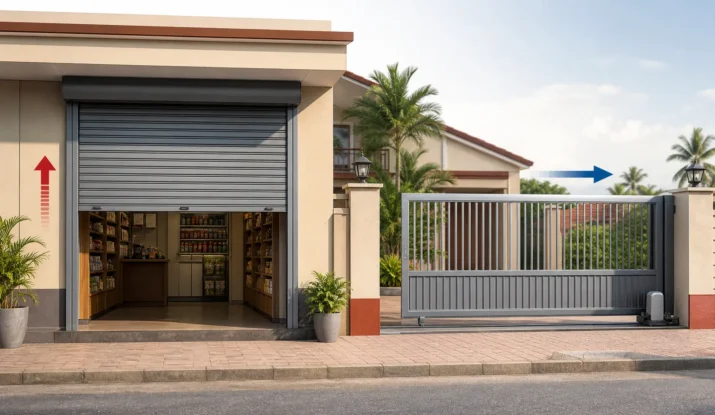
Choosing between roller doors vs sliding gates is not only a design decision. For a retail shop, it affects security, daily access, display protection, customer flow, and long-term maintenance costs.
In most street-facing retail shops, roller doors are usually the more practical choice. They protect the actual shop opening, save space, and are easy to open and close every day. Sliding gates are better for wider entrances, parking areas, yards, warehouses, and shop compounds where side space is available.
Fast Facts
- Best for shopfronts: Roller doors usually offer better direct security and space-saving convenience.
- Best for compounds: Sliding gates suit driveways, car parks, yards, and wider commercial entrances.
- Space matters: Roller doors need headroom, while sliding gates need clear side space.
- Automation helps: Motors improve convenience, but they must match the door or gate weight.
- Weather matters: Sri Lankan rain, humidity, coastal air, and dust make quality materials and maintenance important.
Why This Choice Matters for Retail Shops
A retail entrance has to do more than open and close. It must protect stock after hours, keep staff access simple, and support the way customers move during business hours.
Many shop owners focus only on the price. That can lead to problems later. A weak door, poor track alignment, low-quality steel, or badly installed motor can create security gaps and daily frustration.
Retail shops also face different risks from homes. A shopfront may have glass panels, display shelves, cash counters, expensive stock, and public foot traffic. The entrance needs to resist forced entry while still being practical for staff who use it every morning and evening.
How Roller Doors and Sliding Gates Work
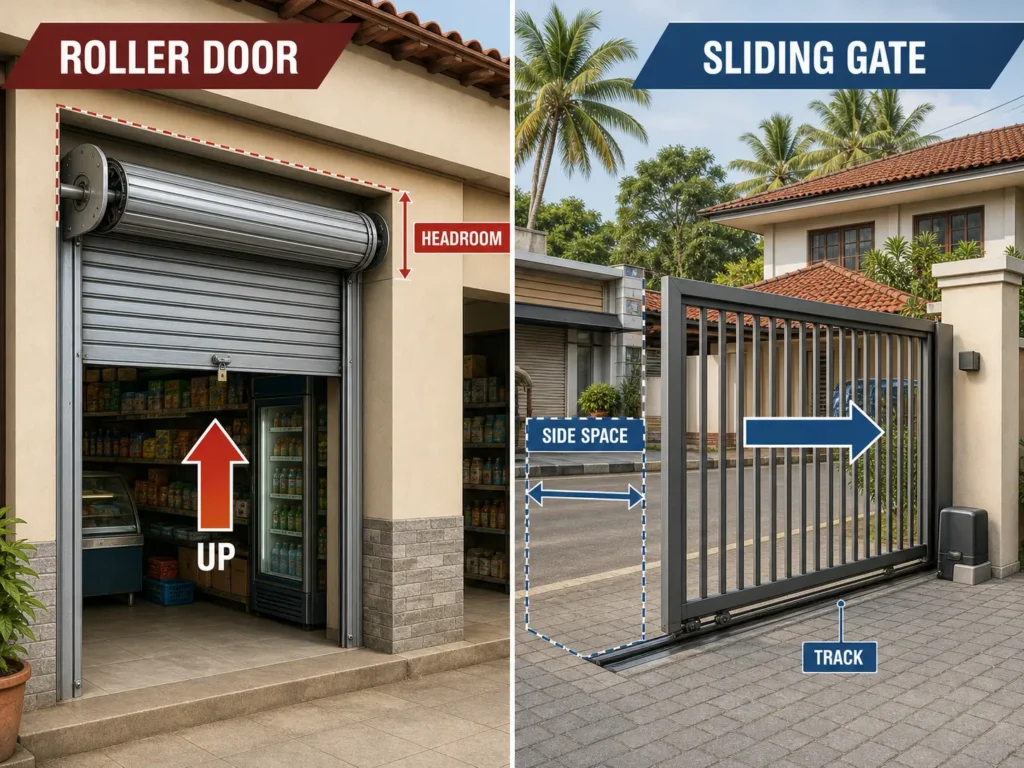
A roller door moves vertically. The curtain rolls up into a drum above the opening. This makes it useful where space is limited, especially in town shops and narrow commercial buildings.
Roller doors are common for retail shutters, shopfronts, garages, warehouses, workshops, and storage areas. They can be manual or motorized. Stronger versions use steel slats, guide rails, locks, and bottom bars to improve protection.
A sliding gate moves sideways along a track or guide system. It is often used at property entrances, driveways, yards, factories, warehouses, and commercial compounds. It can be manual or automated with a gate motor.
The biggest difference is the movement path. A roller door needs headroom above the opening. A sliding gate needs clear side space equal to the gate width. For many retail shopfronts, that single factor decides the answer.
Security, Convenience, and Space Compared
For direct shopfront security, roller doors usually perform better. They close over the entrance itself and help protect glass, display areas, and internal stock. A properly fitted roller door also reduces exposed weak points around the opening.
Sliding gates can be very strong, but they usually secure an outer boundary rather than the shop opening. They work well for shops with parking areas, side yards, loading bays, or front compounds. They are less suitable when the entrance opens directly to the pavement.
Convenience also depends on daily use. Roller doors are quick for staff because they lift upward and do not block the frontage. A motorized roller door can make opening and closing easier, especially for larger shop shutters.
Sliding gates are convenient for vehicle access. They are useful when delivery vehicles or customers need controlled entry to a compound. But for a small retail entrance, a sliding gate can become awkward if there is no side clearance.
Space is where roller doors often win. They do not swing outward, and they do not need a long side track. This helps in busy Sri Lankan towns where shopfront width is limited.
Mistakes Retail Owners Should Avoid
The first mistake is choosing only by price. A cheaper product can become expensive if it bends, rusts, jams, or needs frequent repair.
The second mistake is ignoring measurements. Roller doors need correct opening size, side guides, headroom, and fixing points. Sliding gates need enough side space, a level track, strong posts, and a clear travel path.
The third mistake is treating automation as an afterthought. Motors need the right capacity for the door or gate weight. They also need safe controls, manual release options, and protection from water ingress.
Another common mistake is ignoring safety. powered doors and gates need safe design and maintenance because moving metal systems can create crushing, trapping, or impact risks if installed poorly.
Finally, many shop owners forget long-term service. Dust, rain, corrosion, loose tracks, worn rollers, and weak locks can reduce both security and convenience.
What Experts Recommend for Sri Lankan Shops
For most retail shopfronts in Sri Lanka, a strong roller door is the better first option. It gives direct protection, saves frontage space, and suits daily opening routines.
For shops with a compound, driveway, loading entrance, or large outdoor access point, a sliding gate can be the better choice. It controls vehicles and protects the property boundary before anyone reaches the building.
Material quality matters in both options. Sri Lankan shops often deal with humidity, heavy rain, coastal air, dust, and heat. In exposed areas, hot-dip galvanizing helps protect steel from corrosion, especially when combined with good paint or powder coating.
Shop owners should also consider local rainfall and weather conditions before choosing motors, tracks, finishes, and drainage details.
Good installation is just as important as the product. Industry resources such as technical data sheets for rolling doors and gate operators show how many details affect performance, including wind load, jamb construction, operators, maintenance, and safety devices.
Working with an experienced installer such as Vision Industries can help shop owners choose the right product, measure correctly, plan automation, and avoid common installation problems.
Helpful Guide
If you are comparing access options, this guide on manual vs automatic roller doors can help you understand which setup is better for daily use, security, and convenience.
Which Option Should You Choose?
Choose a roller door if your retail shop opens directly to the road, pavement, arcade, or shopping street. It is also the better option if you need compact operation, direct shopfront protection, and easy daily use.
Choose a sliding gate if your shop has a driveway, car park, yard, warehouse entrance, or wide external boundary. It is better for vehicle control and larger property access.
For many businesses, the best solution may include both. A sliding gate can protect the outer compound, while a roller door secures the actual shopfront or storage entrance.
The right decision depends on five practical questions:
- Does the entrance open directly to the public road?
- Is there enough side space for a sliding gate?
- Do you need to protect a shopfront, a boundary, or both?
- Will staff open it manually or use automation?
- How exposed is the site to rain, salt air, and dust?
For most retail shops, roller doors offer better security and convenience at the shopfront. Sliding gates are still valuable, but mainly for larger premises with outdoor access needs. The safest choice is to match the product to the site, not just the budget.
FAQs
Are roller doors more secure than sliding gates for retail shops?
Yes, roller doors are usually more secure for direct shopfronts because they cover the actual entrance. Sliding gates are strong, but they work best for compounds, driveways, and wider property boundaries.
Which is more convenient for daily retail use?
Roller doors are usually more convenient for daily shop use because they open upward and save space. Sliding gates are convenient when vehicles need controlled entry to a car park, yard, or loading area.
Can both a roller door and sliding gate be used together?
Yes, some retail properties benefit from both. A sliding gate can secure the outer boundary, while a roller door protects the shopfront, storage area, or loading entrance after hours.