
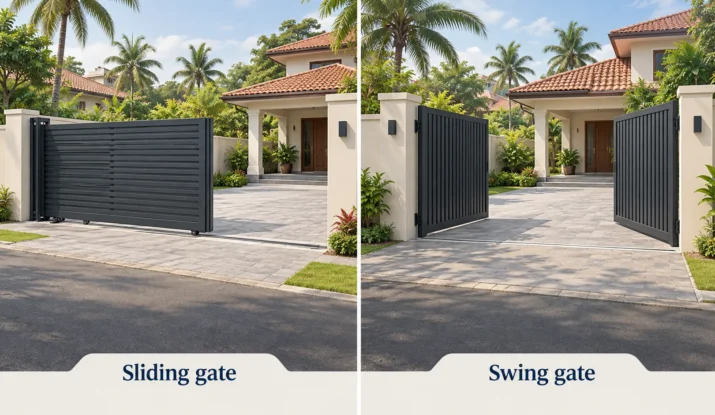
A gate can fit neatly between your entrance pillars and still hit your car when it opens. That is why choosing between sliding gates and swing gates starts with driveway layout.
Sliding gates need clear space beside the entrance. Swing gates need room for their opening arc. Neither mechanism suits every property. Before choosing, picture your gate fully open, your vehicle parked and someone walking through the entrance. The right arrangement needs to accommodate all three.
Fast Facts (TL;DR)
- Sliding gates preserve driveway depth. They need enough clear space beside the entrance for the full panel to retract.
- Swing gates need a clear opening arc. Keep parked vehicles, plants and pedestrian routes outside that area.
- Double swing leaves reduce each leaf’s reach. Both sides still need unobstructed movement space.
- Slope direction matters. Rising ground inside the driveway affects swing clearance; sideways slopes affect sliding travel.
- Cantilever gates need additional side space. Their supporting tail adds length, although no ground track crosses the entrance.
- Measure before choosing. Check opening width, side space, parking depth, ground levels and drainage with an installer.
Check Where Your Gate Will Move
Start with three measurements: the entrance width, the available side space and the driveway depth. Each answers a different question about how your gate will operate.
Entrance width determines the vehicle opening. Side space determines whether a sliding gate can retract fully. Driveway depth helps establish whether a swing gate can open without reaching a parked vehicle.
Swing gates need clearance throughout their opening arc, including intermediate positions. Checking only where the gate rests when fully open can miss an obstruction.
Think about daily use, too. A visitor waiting outside, a delivery vehicle turning in and a pedestrian leaving may need different areas. Mark these positions on a simple entrance sketch.
How Sliding Gates and Swing Gates Open
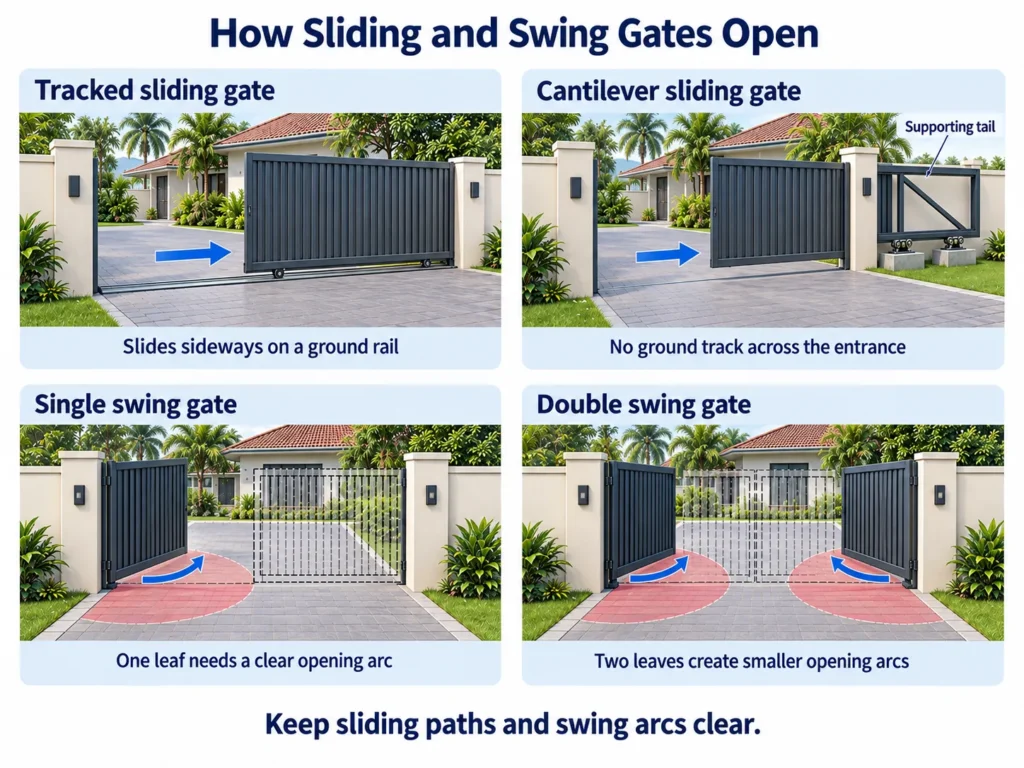
A sliding gate moves sideways along the boundary. A conventional tracked gate runs on wheels over a ground rail. The opening stays free of a swinging panel, which helps preserve driveway depth.
A cantilever sliding gate uses supports beside the driveway to carry the panel above the entrance. It needs no ground track across the opening. However, its supporting tail adds to the gate’s overall length. Ask for the full retraction space required by the selected system.
A swing gate rotates on hinges attached to posts or pillars. The moving panel is called a leaf. A single swing gate has one leaf; a double swing gate usually has two leaves meeting near the centre.
Splitting the opening between two leaves reduces each leaf’s swing radius. Both sides still need clear movement space. Neither arrangement allows you to use the opening arc as a permanent parking area.
Which Gate Fits Your Driveway Layout?
Short driveway with clear side space: Sliding gates often suit this layout because they move beside the entrance. Vehicles must still remain clear of the moving panel and its supporting hardware.
Limited side space with clear inward depth: Swing gates may fit better. Check that each leaf clears walls, steps, plants and parked vehicles throughout its travel.
For example, a four-metre opening could use two approximately two-metre swing leaves. Each leaf sweeps an arc with roughly a two-metre radius. This is a planning illustration, not an installation dimension. Hinge positions and clearances affect the final arrangement.
For a conventional single-panel sliding gate, start by checking for side space roughly equal to the opening width, plus installation allowances. A cantilever system also needs room for its supporting tail. Obtain exact dimensions before committing.
Driveway rising into the property: An inward-opening swing gate may hit the rising surface. A sliding gate can avoid that particular obstruction if its sideways travel path is suitable.
Ground sloping along the boundary: Sliding becomes more complicated. The installer must assess travel levels, ground clearance and protection against uncontrolled movement.
These are two different slope directions. Saying that sliding gates suit “sloping driveways” without distinguishing them can lead to the wrong choice.
If neither movement path fits, reassess the gate position with an installer before selecting a mechanism.
Avoid These Entrance Planning Mistakes
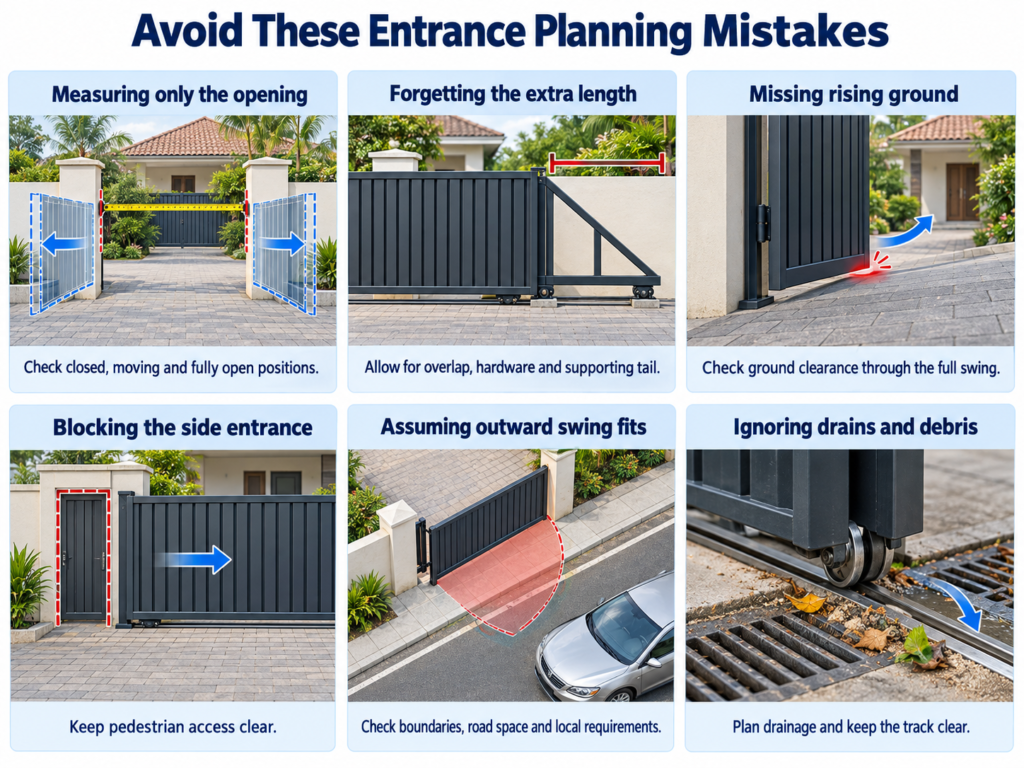
Measuring only between the pillars. A gate must fit when moving and fully open, as well as when closed.
Treating opening width as total gate length. Sliding panels need overlap and hardware allowances. Cantilever gates also include a supporting tail.
Checking ground clearance only at the closed position. A swing leaf can clear the driveway when shut and scrape it halfway through opening.
Forgetting the side entrance. A retracting sliding gate may pass across a pedestrian gate or another frequently used area.
Using outward swing as an automatic solution. Check the property boundary, roadside conditions and space for waiting vehicles. Confirm any applicable local requirements before choosing this arrangement.
Ignoring drains and debris. At Sri Lankan entrances, check where rainwater flows and where sand or leaves collect. A ground track needs a suitable supporting surface and a clear wheel path.
What to Measure Before a Site Visit
Prepare a rough sketch and record:
- Clear vehicle opening: The usable gap required for your vehicles, allowing for their approach angle.
- Side clearance: Unobstructed space to the left and right of the opening.
- Driveway depth: Distance from the gate line to the usual parked-car position.
- Ground levels: Changes across the entrance, along the boundary and inside the proposed swing arc.
- Fixed obstacles: Steps, walls, trees, utility boxes and pedestrian gates.
- Drainage routes: Channels, grates and places where water collects.
Take photographs from both sides of the entrance. Include the full boundary area where a sliding panel would retract.
Ask the installer to confirm the fully open position, remaining vehicle clearance and suitable foundations. The assessment should also identify trapping points around hinges and sliding paths. Powered-gate safety guidance specifically highlights these locations and the need for a site-specific assessment.
Vision Industries can help assess these measurements during a site visit and recommend an opening mechanism suited to the entrance.
Choose the Mechanism That Fits Your Space
Choose sliding gates when you have sufficient side clearance and want to preserve driveway depth. Confirm that the full panel can retract without blocking another entrance or crossing unsuitable ground.
Choose swing gates when the driveway provides a clear opening arc and side storage is limited. Double leaves can reduce the depth each leaf reaches, but the entire swept area must remain clear.
Where slopes, drains or pedestrian routes complicate the layout, request a measured assessment before fabrication. Ask to see the gate’s closed position, opening path and fully open position on the plan.
The most suitable gate is the one that fits how your entrance works every day.
Frequently Asked Questions
How much side space do sliding gates need?
A conventional single-panel sliding gate generally needs side space roughly equal to the opening width, plus installation allowances. Cantilever gates also need space for a supporting tail. Ask your installer for the complete retraction length, including hardware and required clearances.
Are sliding gates suitable for sloping driveways?
Sliding gates may suit a driveway that rises inward, provided the sideways travel path is suitable. Ground sloping along that path creates different challenges. Have the installer assess levels, ground clearance and uncontrolled movement before deciding which mechanism fits.
Do double swing gates need less driveway depth?
Double swing gates generally need less opening depth than one full-width swing leaf across the same entrance. Each shorter leaf sweeps a smaller arc. However, both arcs must stay clear of parked vehicles, rising ground, walls and pedestrian routes.