

Your driveway gate should provide enough clear space for your largest expected vehicle to enter and leave comfortably. That means checking the approach and turning movement, not just the vehicle’s width.
A 12 foot sliding gate might suit your entrance, but the label alone cannot confirm the fit. The vehicle opening, physical gate length, and space beside the driveway are different measurements. Understanding those differences before ordering can help you avoid moving pillars or remaking a gate.
Fast Facts (TL;DR)
- Measure the clear opening: Record the unobstructed vehicle passage with the gate fully open, accounting for posts and projecting fittings.
- Check the approach: A 12 foot sliding gate is not a guaranteed fit. Include mirrors, turning movement, road width, and larger expected vehicles.
- Keep the dimensions separate: Opening width, overall leaf length, and runback are different. Cantilever gates need extra length for a supporting tail.
- Confirm nominal sizes: A 12-foot swing-gate listing may describe the complete opening. Hardware gaps affect the finished leaf dimensions.
- Approve a drawing before fabrication: Confirm the opening, leaf length, movement area, ground clearance, drainage, and equipment locations.
Measure the Clear Opening First
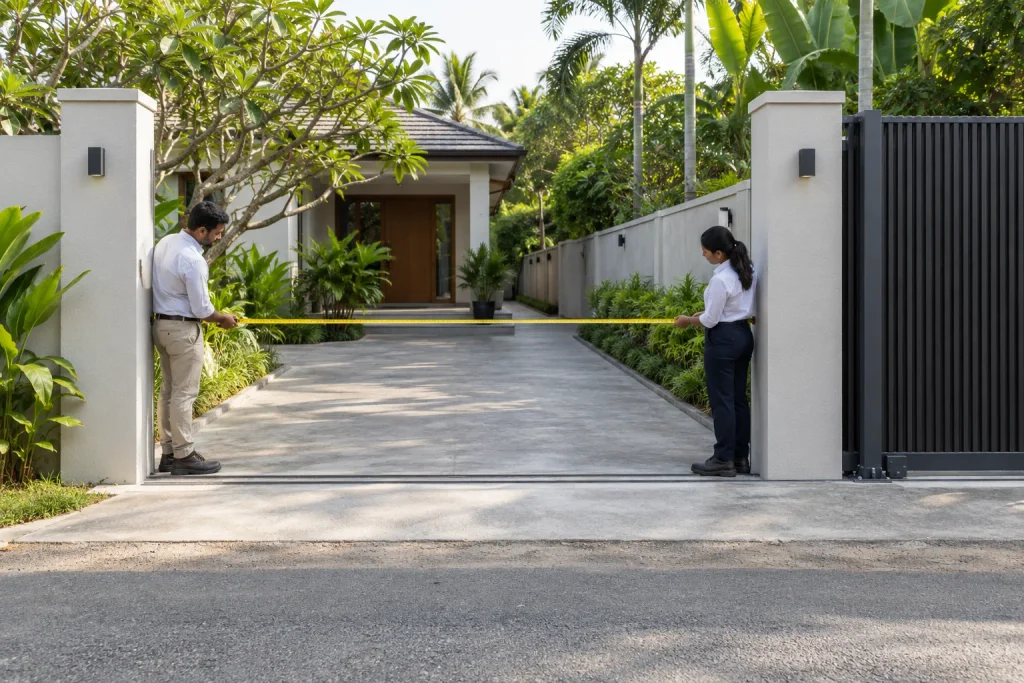
The clear opening is the unobstructed space available for vehicles when the gate is fully open. Start by measuring between the finished inside faces of the entrance posts or pillars. Measure near the bottom, middle, and top, recording any differences.
Next, identify anything that will project into the passage. Hinges, stops, guides, or a gate that does not open completely can reduce usable clearance. For a new entrance, allow for planned plaster, cladding, and other finishes.
Keep these three measurements separate:
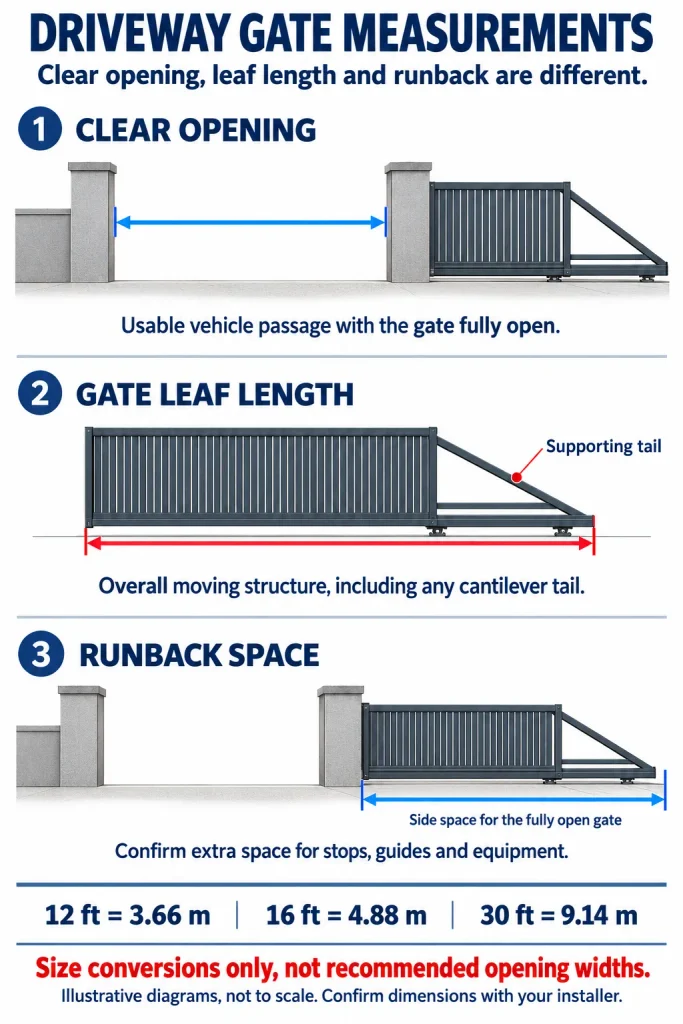
- Clear opening: The usable vehicle passage with the gate fully open.
- Gate leaf length: The overall horizontal length of the moving gate, including any supporting tail.
- Runback: The clear space beside the entrance needed to accommodate an open sliding gate and its installation allowances.
Technical specifications record opening width and available space separately. Your measurement notes and quotation should do the same.
Will a 12 Foot Sliding Gate Be Wide Enough?
A 12-foot clear opening may work for a straightforward vehicle approach, but it is not a guaranteed fit. A sharp turn from a narrow road can require more room than a straight entrance.
Measure your vehicle with its mirrors extended. Then consider its length, turning circle, and the position of nearby walls. Include delivery vehicles, trailers, or larger vehicles you expect to use later.
- 12 feet equals approximately 3.66 metres. Assess this opening against the actual approach before choosing it.
- 16 feet equals approximately 4.88 metres. A 16 foot sliding gate offers more passage width if that figure describes its clear opening. A 16ft sliding gate is the same nominal size.
- 30 feet equals approximately 9.14 metres. A 30 ft sliding gate needs careful planning for vehicle movements, structural support, and side space.
If a listing says “30 sliding gate,” confirm both the unit and what the dimension describes.
For a tight entrance, ask the designer to check the vehicle’s swept path: the space it occupies throughout the turn. Width alone cannot confirm access.
Allow Space for the Whole Gate
A sliding gate needs space beside the opening to park its full moving structure. The exact requirement depends on whether it runs on a ground track or uses a cantilever system.
A tracked gate rolls along a rail. Its leaf usually extends beyond the opening to provide the overlap required by the design. Measure the unobstructed side space and have the installer confirm allowances for guides, stops, and other equipment.
A cantilever gate travels above the driveway without a ground track across the passage. It has a supporting tail behind the section that closes the entrance. This makes the overall leaf longer and increases the space needed beside the driveway.
Do not treat “add 50%” as a universal rule. Tail length depends on the hardware, gate weight, opening, and engineered layout. Runback is also different from travel distance: the leaf must move far enough to clear the entrance and fit within its parking area.
For a 12 foot chain link swing gate, confirm whether the size describes one leaf or a complete double-gate opening. Catalogues may list double-swing gate opening sizes. Two leaves serving a 12-foot opening are not automatically two finished 6-foot panels; hinges and the centre gap affect fabrication dimensions.
Avoid These Measuring Mistakes
The most expensive mistakes often happen before fabrication. Check these points before accepting a gate size:
- Measuring only the paved driveway: The finished posts and fittings determine the available passage.
- Checking only vehicle body width: Mirrors and turning movement also need clearance.
- Ordering the leaf at the opening width: Sliding overlaps and swing hardware require different allowances.
- Ignoring obstacles: Trees, meters, drains, walls, and parked vehicles can block gate movement.
- Assuming extra width solves every problem: Road width, setback, and internal turning space still matter.
Record dimensions in one consistent unit. Include a labelled sketch and photographs so the supplier can distinguish the opening from the available side space.
Check Levels, Drainage, and Safe Movement
Check ground levels throughout the gate’s movement. A swing gate can clear the driveway when closed but strike rising ground as it opens. Sliding gates also need a planned travel line and suitable ground clearance.
For Sri Lankan properties, inspect where heavy rain carries water and debris. Keep drainage routes clear and leave access to clean the track. On coastal sites, discuss corrosion protection for the frame, track, and fittings.
Provide room for the motor, guides, stops, and maintenance access. Ask the installer to assess trapping and crushing hazards throughout the movement area. Overseas safety guidance can inform good practice, but it does not replace applicable Sri Lankan requirements.
Agree on track, roller, and safety-equipment checks, following the selected system’s instructions. Confirm that the manual release remains accessible during a power failure.
Confirm These Dimensions Before Ordering
Request a dimensioned installation drawing before fabrication. It should show:
- The required clear vehicle opening and finished post spacing.
- The overall leaf length, including any cantilever tail.
- The required runback or swing area.
- Ground clearances and the fully open position.
- The locations of automation, stops, guides, and safety equipment.
Ask the quotation to identify any pillar relocation, foundations, drainage work, or electrical work. These can affect the budget beyond the gate itself.
A site measurement visit with Vision Industries can help turn your initial measurements into an installation proposal. Choose the opening around your vehicle access needs, then confirm that the complete gate system fits the property.
Frequently Asked Questions
Is a 12 foot sliding gate wide enough for a driveway?
A 12-foot clear opening may suit your driveway, but suitability depends on the vehicle and approach. Check mirror width, turning movement, road width, and gate setback. Confirm that “12 foot” describes the unobstructed opening rather than the physical gate leaf.
How much runback space does a sliding gate need?
A sliding gate needs enough side space to accommodate its full leaf and installation allowances when open. Cantilever gates also include a supporting tail. Ask for a drawing showing the required runback, stops, guides, and motor position before setting posts.
Does a 12-foot double swing gate have two 6-foot leaves?
Not necessarily. A 12-foot designation may describe the opening served by both leaves, while their finished widths allow for hinges and the centre gap. Confirm the supplier’s sizing convention and hardware dimensions before ordering or installing the gate posts.