
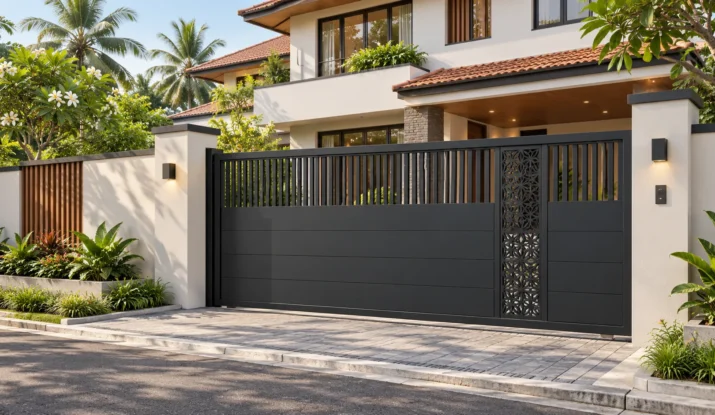
A front gate is one of the largest features in a home’s street view. It can make the property feel private, welcoming, modern or unnecessarily closed.
Choosing a gate design in Sri Lanka should therefore begin with more than a reference photo. The design needs to control the right views, complement the house and remain visually balanced across the full entrance.
Fast Facts: Gate Design Sri Lanka
- Choose privacy by identifying the exact views that need screening.
- Mixed infill can balance privacy with useful street visibility.
- Repeat the house’s lines, proportions and exterior colours.
- Black looks crisp but can make thick or crowded designs feel heavy.
- Mesh and chain-link infill retain more visibility than solid panels.
- Review the gate, pillars, wall and house together before approving the design.
Gate Design Sri Lanka: Start With the View You Want to Control
Before choosing a pattern, stand outside the property and study what is visible. Can passers-by see directly into a living room, courtyard or ground-floor bedroom? Does the driver need a clear view of pedestrians and traffic near the entrance?
These questions reveal where privacy matters. They also show where openness remains useful.
A fully covered gate blocks most views in both directions. That may suit a house close to a busy road. However, it can also hide the front garden and reduce natural surveillance, meaning residents and neighbours see less of what happens near the entrance.
An open design creates a lighter frontage and preserves sightlines. The compromise is greater visibility into the property. Many homes need a combination rather than either extreme.
Solid, Open or Mixed Infill?
Solid infill creates the strongest visual screen. It suits entrances where the road faces private rooms or outdoor living areas. Large uninterrupted panels can look calm on a simple modern façade, but they may appear heavy beside a narrow house or low boundary wall.
Open infill uses visible gaps between bars, slats or patterns. It allows light and views through the gate. Vertical lines often create a taller, formal appearance. Horizontal lines tend to look wider and more contemporary.
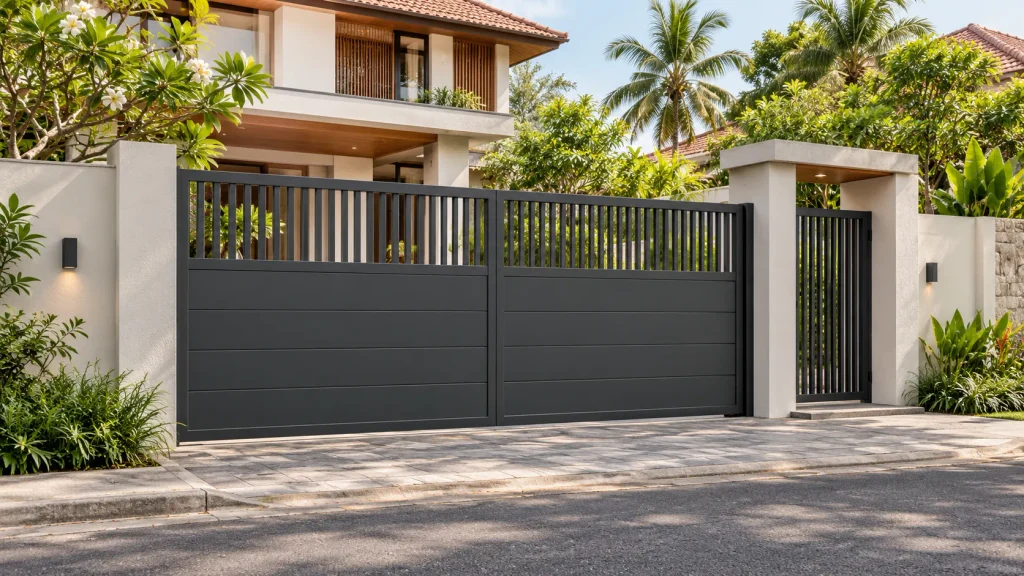
Mixed infill places solid and open sections within one composition. For example, the lower portion can limit direct views while the upper portion remains open. A screened central band can protect the main sightline without covering the entire gate.
This approach works well when privacy is needed at eye level but some street visibility should remain. The transition between sections should look intentional. Repeated spacing and aligned edges help the design feel unified.
Make the Gate Belong to the House
Beautiful sliding gates and swing gates usually share one quality: they look connected to the building behind them.
Start with the house’s strongest lines. A home with flat roofs, rectangular windows and clean parapets normally suits a restrained geometric gate. Arches, curved balconies or traditional detailing can support softer shapes or limited ornamental work.
Proportion matters as much as pattern. Broad entrances can carry larger shapes. Narrow entrances usually look cleaner with smaller repeats or fewer divisions. Gate panels should also align visually with pillars, wall joints or nearby windows where possible.
Treat the façade, roof, windows, boundary wall and landscaping as one exterior colour palette. Repeating an existing dark trim colour often creates a more settled result than adding a new shade. Test the proposed colour on a large sample and view it in morning sun, shade and evening light.
Why Black Gates Work, and When They Do Not
A black sliding gate can create sharp contrast against white, cream or pale grey walls. A black swing gate can produce the same effect. The opening format does not determine the colour’s success. The surrounding architecture does.
Black outlines shapes clearly. This makes simple slats and geometric patterns look crisp, but it can also make thick frames and crowded decoration feel heavier.
Charcoal, deep bronze or another near-black tone may provide a softer alternative. If the house already has dark window frames, railings or roof details, repeating that tone can connect the gate to the façade. On a very dark frontage, a lighter or warmer accent may prevent the entrance from disappearing into one large block.
Mesh, Chain-Link and Decorative Patterns
Mesh infill provides more screening than widely spaced bars while retaining some light and visibility. Fine patterns appear denser from a distance, so always review a full-size sample from the road rather than only viewing it close up.
A chain link fence sliding gate has a practical, open appearance. It preserves views across the boundary, but its repeated diamond pattern can feel more functional than decorative. A coordinated dark colour, clean outer frame and nearby planting can help it sit more comfortably within a residential frontage.
Decorative screens offer stronger visual identity. Geometric perforations suit many contemporary homes. Floral, scroll or heritage-inspired patterns can complement traditional architecture. The pattern should have quiet space around it. Covering every panel with detailed motifs often makes the entrance look busy.
One focal section usually has more impact than decoration across the entire gate. House numbers or a distinctive centre panel can provide character without overwhelming the façade.
A Simple Gate Design Checklist
Review the complete entrance elevation before approving the design. A useful drawing or visual mock-up should show the gate, pillars, boundary wall and nearby part of the house together.
Ask these questions:
- Which exact views need screening?
- Where should drivers and residents retain visibility?
- Does the infill feel too open or too solid from the road?
- Do the main lines relate to the house?
- Does the colour repeat or complement the exterior palette?
- Is one element acting as the focal point?
- Will the pattern still look balanced across the full gate width?
Avoid copying a fashionable design without adapting it to the property. A gate that looks elegant in isolation may feel oversized, crowded or disconnected once installed.
An experienced designer or fabricator should help translate the home’s architecture into a clear elevation before work begins. Vision Industries can support this process with site-based design guidance and custom gate planning for Sri Lankan homes.
The best gate is not simply the most private or decorative option. It controls the right views, preserves useful visibility and looks like a considered part of the home.
Frequently Asked Questions
Which gate design provides the most privacy?
Solid infill provides the greatest privacy, but mixed infill is often more balanced. Place screening where direct views enter private rooms, then retain open sections where residents and drivers need visibility around the entrance.
Does a black gate suit every Sri Lankan home?
No. Black works best when it repeats an existing exterior detail or creates deliberate contrast with a light façade. Charcoal or deep bronze may suit homes where pure black makes the entrance look too heavy.
Can a chain-link sliding gate look attractive at a home?
Yes. Use a clean frame, a colour related to the house and simple landscaping to soften the functional mesh pattern. Selective screening can add privacy, but covering the full gate removes the visibility that makes chain-link useful.