
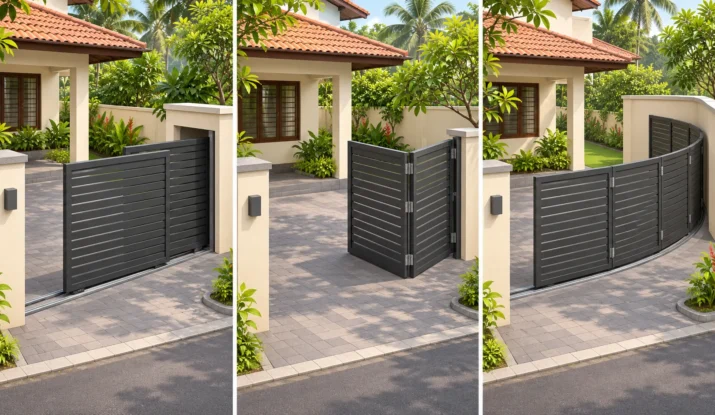
A wide driveway entrance does not always come with enough boundary wall for a conventional sliding gate. Swing gates can create another problem: their opening path may occupy the space where you need to park.
A telescopic sliding gate, folding arrangement or curved-track system may offer an alternative. Each uses space differently. The useful question is not simply which gate looks compact, but where every panel will move throughout opening and closing.
Fast Facts (TL;DR)
- A telescopic sliding gate overlaps multiple panels to reduce straight runback. Exact clearance depends on the selected system.
- Folding gates reduce the sweep of a full-length swing leaf, but still need room to fold and park.
- Around-the-corner gates follow a curved track into a boundary return. The turning area and storage path must remain clear.
- Measure the full movement path. Include parked vehicles, pedestrian access, slopes, drains and maintenance space.
- Plan beyond the motor. Check trapping-point protection, corrosion resistance, manual release and replacement parts.
- Confirm feasibility before ordering. Ask Vision Industries whether it can fabricate, automate and support the proposed specialist layout.
Measure the Opening and the Space Beyond It
Start with the clear opening: the usable width vehicles need to pass through. Then measure the available runback, meaning the space beside the entrance where sliding panels can park.
A conventional single-leaf sliding gate needs enough straight space to accommodate its open leaf and installation allowances. A telescopic design reduces that straight runback. Folding and corner-tracking layouts use different areas around the entrance.
Record the space inside the driveway too. Folding panels need clearance while moving, even when their final parked position looks compact.
- Mark walls, pillars, drains, steps and changes in ground level.
- Show parked vehicles and the route people use on foot.
- Measure any boundary return that could accommodate a curved track.
- Ask for a drawing showing closed, partly open and fully open positions.
This drawing helps reveal conflicts that a photograph of the closed gate cannot show.
How a Telescopic Sliding Gate Saves Side Space
A telescopic sliding gate uses two or more sliding leaves that overlap as they open. A linked mechanism coordinates their movement, allowing the panels to gather within a shorter straight runback.
The leaves slide alongside each other rather than folding at hinges. This makes the arrangement worth assessing when some side space exists, but a full-width single leaf cannot fit.
However, “half the opening width” is not a reliable installation rule. Overlaps, guides, stops, motor positioning and the selected support system affect the final dimensions. More panels also require space across the depth of the stacked assembly.
For example, a four-metre entrance with two metres beside it should trigger a layout check, not an automatic promise of suitability.
Tracked and cantilever telescopic systems also have different support requirements. A cantilever arrangement avoids a track across the driveway, but its supporting structure still needs room.
Ask the installer to confirm the complete footprint and maintenance access before choosing the number of panels.
Folding or Around-the-Corner: Where Will the Panels Go?
Automatic folding gates
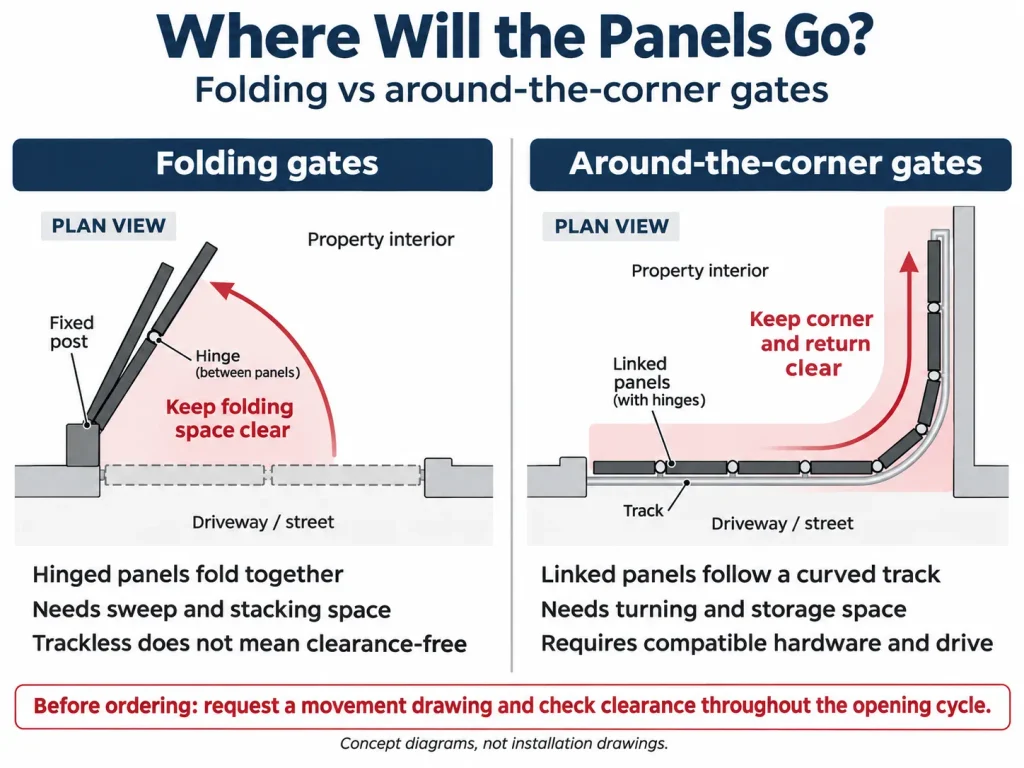
Automatic folding gates use hinged sections that fold together during opening. They can reduce the inward sweep compared with an equivalent full-length swing leaf.
Some manufacturers provide folding systems without a ground track. However, trackless does not mean clearance-free. The panels still sweep through an area and form a folded bundle near their supports.
This option deserves consideration where straight runback is limited but suitable folding space remains. Check the movement against parked cars, pedestrians and nearby walls. A rising driveway also needs assessment throughout the opening cycle.
If a quotation describes an “automatic sliding folding gate,” request a movement drawing. The name alone does not explain whether panels slide, pivot or combine both movements.
Around-the-corner sliding gates
In an around the corner sliding gate, connected panels follow a curved track into a return along the boundary. Hinges and suitable wheel assemblies allow the sections to change direction.
An automatic curved sliding gate therefore needs a compatible drive arrangement, not simply a standard gate placed on bent track.
A corner sliding gate can use perimeter space that a straight slider cannot reach. However, the corner needs sufficient turning clearance, and the entire storage route must remain unobstructed. Track radius, panel dimensions, surface conditions and safeguarding depend on the chosen system.
Avoid These Space-Saving Gate Mistakes
The most expensive mistake is ordering the gate before confirming its full movement path. A compact open position does not prove the gate can reach that position safely.
Other mistakes include:
- Choosing automation too early: the drive must suit the mechanism, operating loads and expected usage.
- Ignoring trapping points: overlapping panels, folding hinges and gaps beside walls require attention.
- Assuming an easy conversion: cutting an existing gate into sections does not establish structural or automation suitability.
- Comparing incomplete quotations: check whether foundations, drainage, wiring, protective devices and commissioning are included.
A competent installer should assess the complete powered gate, including its surroundings. Appropriate guarding, detection devices and safety testing must address the actual hazards. A photocell across the entrance does not necessarily protect every hinge or gap between moving panels.
Plan for Rain, Corrosion and Regular Servicing
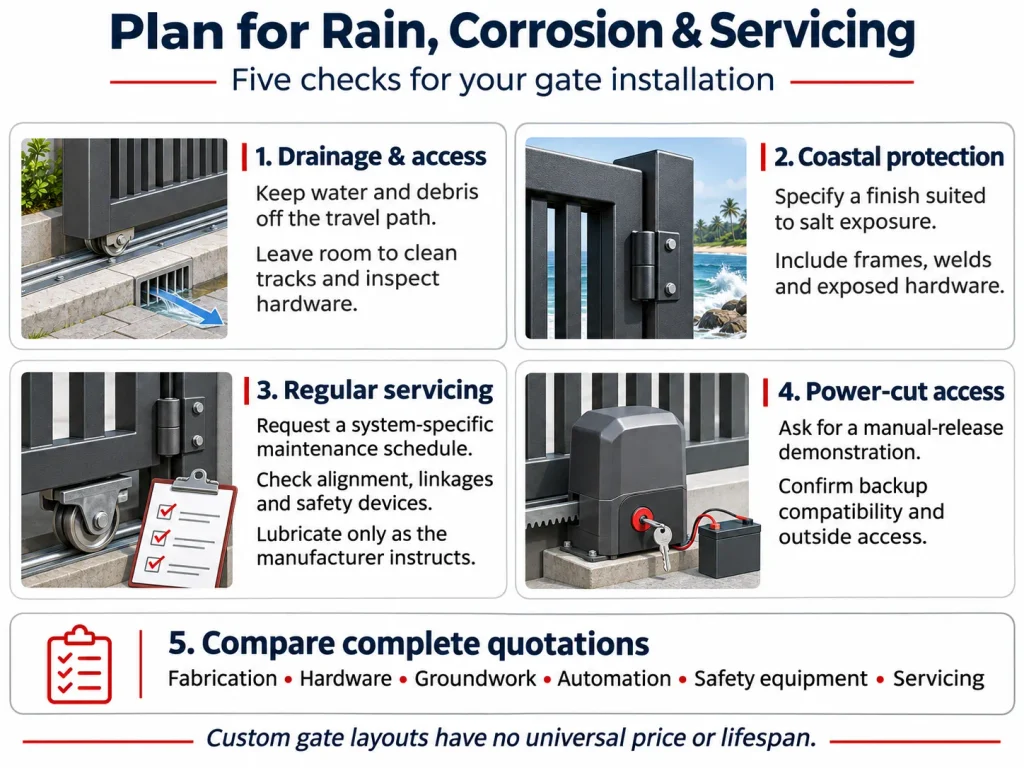
For a Sri Lankan property, include drainage and exposure in the site survey. Water and debris should not collect along the travel path. Leave access for cleaning tracks and inspecting rollers, guides and hinges.
Near the coast, salt exposure affects corrosion. Ask for a finish specification suited to the location, including protection for frames, welds and exposed hardware. A general “rust-resistant” description is not enough to compare proposals.
Request a maintenance schedule for the selected system. Tasks may include cleaning, alignment checks and inspection of linkages and safety devices. Follow the manufacturer’s lubrication instructions rather than greasing every component.
Also request a demonstration of manual release for power cuts. Confirm whether compatible backup power is available and how access works when nobody can reach the release from outside.
Compare quotations by fabrication, hardware, groundwork, automation, safety equipment and servicing. There is no dependable universal price or lifespan for these custom layouts.
Choose the Layout Your Site Can Support
Use the available space to narrow the choice:
- Short straight runback: assess a telescopic arrangement.
- Little runback but usable folding clearance: assess folding panels.
- A clear boundary return: assess a curved-track system.
These are starting points, not installation guarantees. Request a dimensioned layout, hardware specification, safety plan and written quotation.
Before choosing one of these layouts, ask Vision Industries to confirm whether it can fabricate, automate and support the proposed system for your site. Confirm replacement-part availability too. The right choice should preserve access and parking space while remaining practical to operate and maintain.
Frequently Asked Questions
How much side space does a telescopic sliding gate need?
A telescopic sliding gate needs a system-specific runback allowance, not simply half the entrance width. Panel overlaps, guides, stops and motor positioning affect the footprint. Ask for a dimensioned drawing showing the clear opening, stacked-panel depth and maintenance access before ordering.
Can an automatic sliding gate go around a corner?
Yes, a purpose-designed sectional gate can follow a curved track around a corner. It needs compatible hinges, wheels, guides and automation. The installer must confirm the turning radius, panel clearances, track support and protection around the full travel path.
Are automatic folding gates suitable for a short driveway?
Automatic folding gates can suit a short driveway when their reduced sweep clears parked vehicles and pedestrian routes. They still need room to fold and park. Check the complete movement path, ground slope, support positions and hinge protection before selecting the layout.