
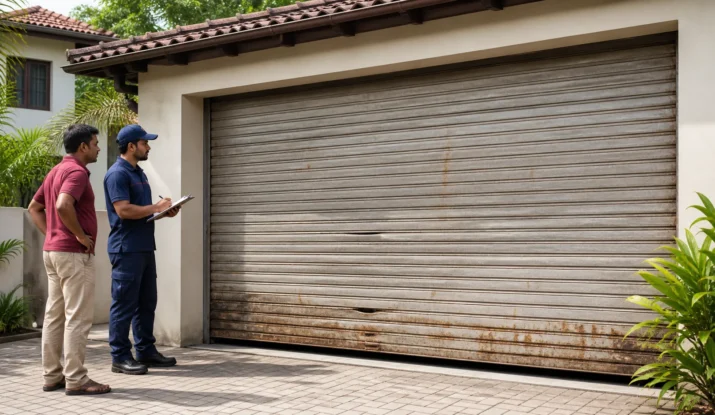
An old roller door rarely fails without warning. It may become noisy, slow, uneven, rusty, or unreliable first. The difficult part is deciding whether it needs another repair or a complete replacement.
If you plan to replace a roller door in Sri Lanka, assess its condition, safety, usage, and repair history together. Age matters, but it should never be the only reason for your decision.
Fast Facts: Roller Door Replacement
- Typical planning range: A good-quality roller door may provide about 10 to 20 years of service, depending on usage and care.
- Age is not the only test: Operating cycles, corrosion, installation quality, and maintenance strongly affect useful life.
- Key replacement signs: Repeated failures, uneven movement, structural rust, security gaps, unreliable safety systems, and unavailable parts.
- Repair may still work: A single replaceable fault does not always require a complete new door.
- Sri Lankan conditions matter: Coastal salt, humidity, heavy rain, commercial usage, and power interruptions should influence the specification.
- Safety first: Do not adjust springs, cables, or barrel assemblies yourself. Request a professional inspection of the complete system.
How Long Should a Roller Door Last?
A good-quality roller door can often provide about 10 to 20 years of service. Some last longer. Others fail much earlier because of poor materials, incorrect installation, heavy use, impacts, or corrosion.
Operating cycles matter as much as calendar age. One cycle means opening and closing the door once. A home garage used twice daily places far less demand on its components than a shop door opened dozens of times each day.
Different parts also age at different rates. The curtain may remain sound while the motor, spring, bearings, seals, or controls wear out. Spring life does not always match the lifespan of the complete door.
Treat 10 to 20 years as a planning range, not a guaranteed replacement date. A professional condition assessment gives a more reliable answer.
Seven Signs Your Old Door Is Ready for Replacement
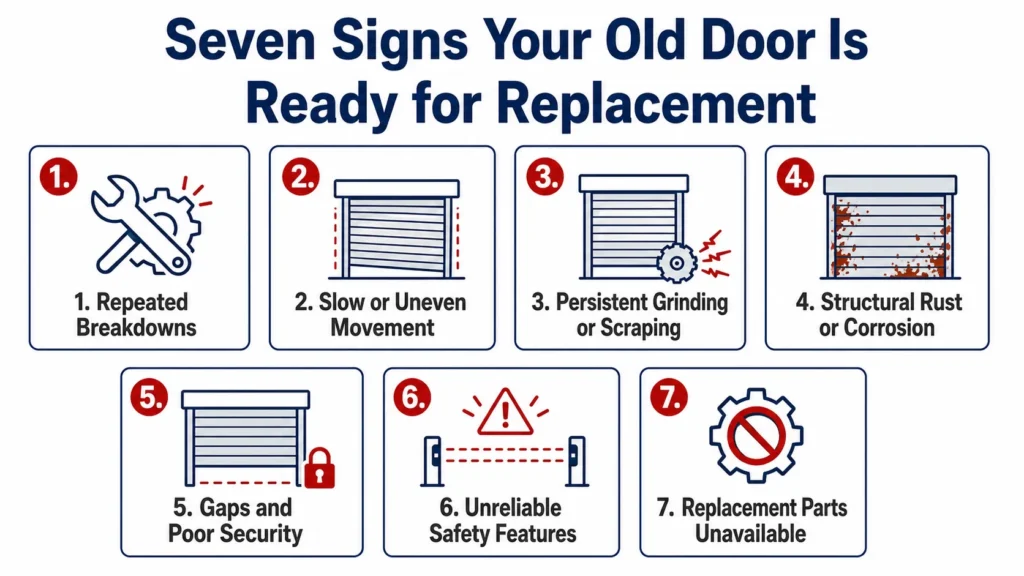
1. Breakdowns Keep Returning
One isolated fault may justify a repair. Several failures within a short period suggest wider deterioration.
Add the cost of previous repairs to the next quotation. Replacement may offer better value if you keep paying to restore an unreliable system.
2. The Door Moves Slowly, Unevenly, or Unpredictably
A roller door should travel smoothly through its guides. Jerking, tilting, sticking, or dropping can point to damaged guides, poor balance, worn parts, or spring problems.
Stop using a door that looks unstable. A severely unbalanced door can fall unexpectedly.
3. Grinding and Scraping Continue After Servicing
New sounds are useful warnings. Grinding can indicate metal contact, damaged bearings, alignment problems, or a struggling motor.
Lubrication may solve a minor maintenance issue. It will not correct a bent guide, weakened spring, distorted curtain, or failing drive system.
4. Rust Has Become Structural
Light surface staining may be treatable. Deep corrosion, perforated slats, flaking metal, and weakened lower sections require closer inspection.
Rust on springs, brackets, fasteners, or guides deserves particular attention. Corrosion can reduce metal strength even when the door still operates.
5. The Closed Door No Longer Protects the Opening
Look for gaps at the sides, bottom, or between slats. Check whether the door can still close and lock properly.
A distorted curtain or damaged guide can reduce resistance to forced entry. It may also allow wind-driven rain, dust, and pests into the building.
6. Automatic Safety Features Are Unreliable
An automatic door should stop or reverse when its safety system detects an obstruction. Sensors, safety edges, controls, and travel limits must work consistently.
Disconnect an automatic door that fails its manufacturer-specified safety test. Arrange professional repair or replacement before using it again.
7. Suitable Parts Are No Longer Available
An old motor or control board may become difficult to support. Repeatedly adapting incompatible parts can create reliability and safety problems.
Replacement becomes more practical when the system is obsolete and its main components cannot be sourced with dependable warranties.
Repair or Replace? Use This Practical Test
Repair is usually reasonable when the problem is limited to one replaceable component. Examples include a worn seal, remote-control fault, localised guide adjustment, or serviceable motor problem. The curtain and main supporting parts should still be structurally sound.
Replacement deserves stronger consideration when the door has several connected problems. Examples include widespread corrosion, bent slats, damaged guides, unreliable controls, repeated motor strain, and poor security.
Do not replace the motor before checking the door itself. A new motor may also struggle if the curtain binds or the counterbalance system is faulty.
Ask for separate repair and replacement quotations. Each should identify the fault, included components, safety work, warranty, and expected service support. Compare the likely ownership cost, not just the smallest initial figure.
Why Sri Lankan Conditions Can Shorten Door Life
Sri Lanka’s climate can be demanding on metal access systems. Coastal air carries salt, while humidity and frequent rain keep vulnerable surfaces wet.
Salt exposure is not limited to buildings beside the beach. Wind direction, shelter, temperature, and distance from the sea all affect corrosion. Guides and brackets under covers may deteriorate quickly because rainfall does not rinse them.
Choose materials and protective finishes for the actual site. Ask how the curtain, guides, fasteners, brackets, and repaired edges will resist corrosion. Follow the manufacturer’s cleaning instructions, especially in coastal areas.
Heavy commercial usage is another local concern. A shop entrance may complete more cycles in one year than a residential door completes in several years. The motor and counterbalance system must suit this workload.
For an automatic replacement, request a safe manual-release method. Users should know how to operate it during a power interruption without touching high-tension parts.
Helpful Guide
Compare the durability, corrosion resistance, and suitable applications of aluminium, steel, Zincalume, and stainless-steel roller doors before choosing your replacement.
Replacement Mistakes That Create New Problems
Avoid choosing a door from its appearance and price alone. Material quality, curtain thickness, guide strength, motor capacity, safety devices, corrosion protection, and installation all affect long-term value.
Do not reuse unsuitable old parts simply to reduce the quotation. Ask the installer to explain which parts will remain and why they are compatible.
Never adjust springs, cables, or barrel assemblies without suitable training. These parts can store enough force to cause serious injury.
Measure the opening professionally. The installer should check width, height, headroom, side room, fixing surfaces, electrical supply, drainage, and the path of people or vehicles.
Finally, confirm who will provide future servicing. A low initial price offers little value if compatible parts and technical help are unavailable later.
Plan a Safer, Longer-Lasting Replacement
Start with a complete inspection rather than assuming that every old door needs replacement. Ask the technician to assess:
- Curtain and slat condition
- Guides, brackets, fasteners, and barrel
- Springs or other counterbalance parts
- Motor, controls, wiring, and manual release
- Safety sensors and obstruction protection
- Locks, seals, drainage, and closing gaps
- Corrosion exposure and protective finish
- Expected daily operating cycles
- Spare-parts availability and warranty
The inspection should leave you with a clear diagnosis. You should know what can be repaired, what must be replaced, and what could fail next.
Working with an experienced supplier such as Vision Industries can help coordinate measurement, product selection, installation, automation, testing, and after-sales support. The best replacement is not simply a newer door. It is a complete system matched to the site, workload, weather, and safety needs.
Frequently Asked Questions
How long does a roller door usually last in Sri Lanka?
A well-built roller door can often last about 10 to 20 years. Its actual lifespan depends on daily operating cycles, material quality, installation, maintenance, impacts, and coastal exposure. Condition is more useful than age alone when deciding whether replacement is necessary.
Should I repair or replace my old roller door?
Repair is usually suitable for one isolated fault when the curtain, guides, and supporting structure remain sound. Consider replacement if corrosion, repeated breakdowns, structural damage, obsolete controls, poor security, or unavailable parts affect several parts of the system.
Can I replace only the motor on an old roller door?
Yes, but only if an inspection confirms that the door moves freely and remains properly balanced. A new motor will not correct damaged guides, a binding curtain, or a faulty counterbalance system. Ask a qualified technician to test the complete door before replacing the motor.