
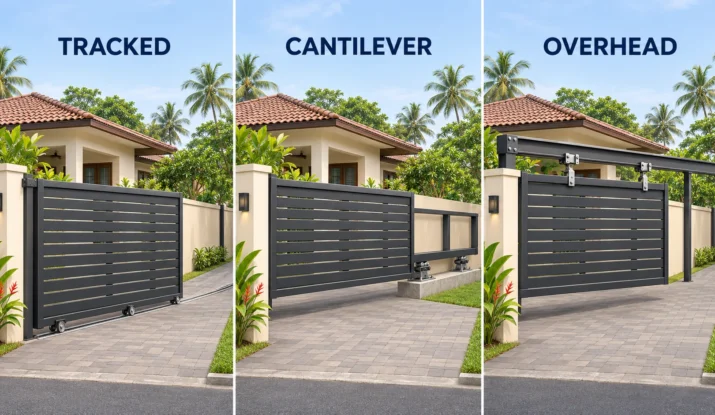
A sliding gate can look right on paper but struggle with the driveway beneath it. Loose stones, uneven paving or limited side space can change which mechanism makes sense. A cantilever sliding gate removes the ground rail, but needs suitable foundations and extra room beside the opening.
The choice starts with where the gate carries its weight: on a ground track, on cantilever supports or from an overhead beam. Each arrangement solves different problems and introduces its own site requirements.
Fast Facts (TL;DR)
- Three support methods: Tracked gates carry weight on a driveway rail, cantilever gates use side supports, and overhead gates hang from an elevated track.
- Tracked gates: Suit a stable running surface and generally need less side space than comparable cantilever gates. Keep the rail clear of debris.
- Cantilever sliding gates: Avoid a ground rail but need space for the rear extension and a properly designed foundation. Exact dimensions depend on the system.
- Overhead gates: Keep the driveway free of a load-bearing rail, but require structural support, side parking space and adequate vehicle headroom.
- Before ordering: Confirm ground clearance, drainage, coastal exposure, maintenance access and the complete installed cost in a measured site proposal.
Key distinction: Clearing uneven ground does not mean a cantilever gate can travel uphill.
Start With Ground, Side Space and Headroom
Before comparing prices, check three things: the ground across the entrance, the space beside it and the height above it.
The clear opening is the usable width vehicles pass through. Side parking space, often called run-back space, is where the gate sits when fully open. Measure both. A wide entrance does not guarantee enough room for the complete gate to slide aside.
Inspect the surface along the full travel path. Note changes in level, drains, loose gravel and places where rainwater collects. For overhead support, also identify the tallest vehicle likely to enter.
These checks help prevent expensive redesigns after fabrication. They also reveal whether a seemingly cheaper mechanism needs substantial additional building work.
How a Cantilever Sliding Gate Differs From Other Systems
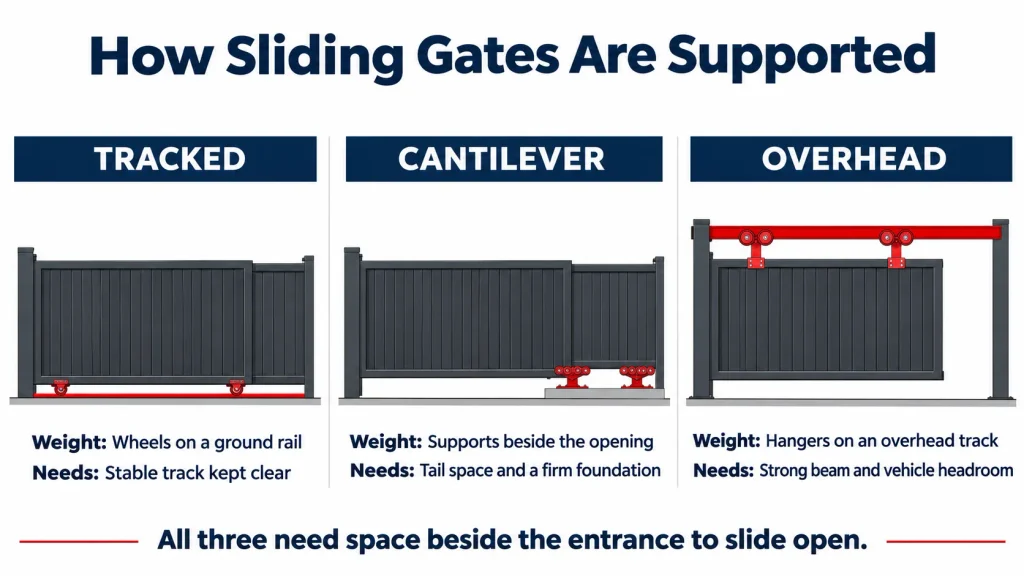
Ground Track: Weight on Driveway Wheels
A tracked sliding gate carries its weight through wheels running along a fixed ground track. Guides keep the gate aligned as it moves.
This arrangement suits entrances where a stable, straight running surface can be installed. It generally needs less side space than a comparable cantilever gate because it has no cantilever tail. However, the full gate still needs somewhere to park.
The main compromise sits at driveway level. Stones, mud and damaged or misaligned track sections can interfere with movement.
Cantilever: Support Beside the Opening
A cantilever gate carries its weight through supports beside the entrance, leaving the driveway free of a ground rail. In a common cantilever sliding gate system, a beam attached beneath the gate moves over fixed roller carriages.
A rear extension provides the length needed for the support arrangement. Its dimensions depend on the hardware, opening width and gate weight. The foundation, carriage spacing and frame strength must work together.
This mechanism can suit gravel, uneven surfaces or entrances where maintaining a driveway track would be difficult.
Overhead: Support From Above
A hanging sliding gate, as used here, is suspended from an overhead track. Wheeled hangers carry the gate beneath a structural beam, while guides control its movement.
An overhead slide gate avoids a load-bearing ground rail and the same cantilever tail arrangement. However, it still needs side parking space. Its beam and supporting structure also impose a vehicle-height limit that must suit the site.
Compare Installation Costs and Maintenance
Compare complete installations using the same opening size, gate finish and operating requirements. A lower gate-frame price does not always produce a lower final bill.
- Tracked system: Include the rail, supporting base, drainage details and any driveway repairs after installation.
- Cantilever system: Include the longer gate assembly, specialist supports, excavation and designed foundation.
- Overhead system: Include the beam, posts or verified building supports, plus access for installation and servicing.
Tracked gates need debris removal and checks for track damage or movement. Cantilever gates avoid driveway-track cleaning, but their supports, guides and fixings still need inspection. Overhead systems also require access to elevated running components.
Follow the selected hardware’s servicing instructions. Do not assume every roller needs grease or every installation needs the same maintenance interval.
For coastal Sri Lankan properties, specify corrosion protection suited to the environment. Steel protection, exposed fixings and coating repairs deserve attention. Aluminium components do not make the entire assembly immune to corrosion.
Avoid These Gate Selection Mistakes
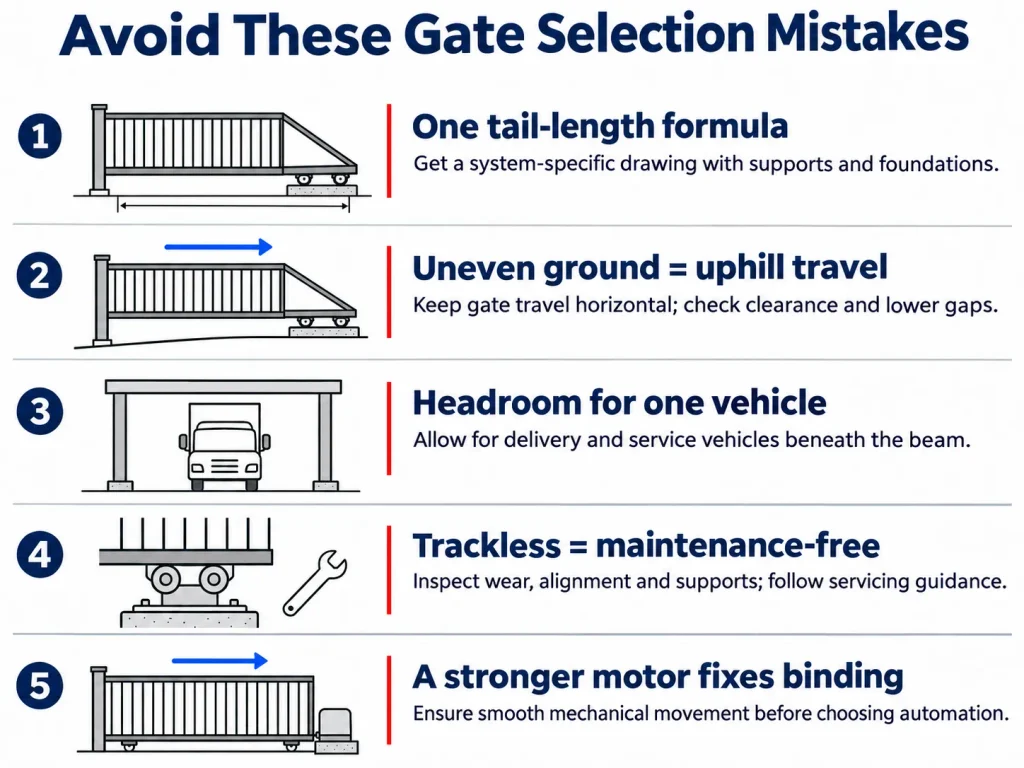
Using a universal tail-length formula. Cantilever dimensions vary between systems. Ask for a drawing showing the entire gate in its open and closed positions, including the foundation and support locations.
Confusing uneven ground with uphill travel. A cantilever gate can clear changes in ground level without following them. Manufacturer guidance distinguishes horizontal travel above sloping ground from a gate travelling on an incline. Check clearance at the highest point and the resulting gap at lower points.
Checking headroom against one vehicle. An overhead beam must accommodate expected delivery and service vehicles, not just the car currently using the entrance.
Assuming trackless means maintenance-free. Removing the driveway rail changes the maintenance tasks. It does not remove wear, alignment checks or servicing needs.
Expecting a stronger motor to solve mechanical problems. Establish smooth, controlled gate movement before selecting automation.
What Your Site Survey Should Confirm
A useful site survey should produce more than an opening measurement. Ask the installer to record:
- The clear opening, available run-back space and clearance throughout the travel path.
- Ground levels, drainage routes and nearby underground services.
- Foundation requirements and the suitability of any existing supporting structure.
- Gate weight, panel design, wind exposure and expected daily use.
- Vehicle headroom where overhead support is proposed.
- Access for maintenance, replacement parts and emergency operation.
For Sri Lankan sites exposed to heavy rain, examine where runoff carries silt or leaves. Removing a ground track does not solve poor drainage or protect electrical equipment from flooding.
For automated gates, request safety-device checks and emergency-release instructions. The installer should assess trapping points throughout the movement path, including beside fences and posts. Protective devices must suit those risks.
Ask for a practical demonstration of power-failure operation and a written maintenance plan at handover.
Choose the Mechanism Your Site Can Support
Choose a tracked gate when a stable running track is practical, side space is sufficient and routine track cleaning is manageable.
Choose a cantilever sliding gate when avoiding a driveway rail offers a clear advantage and the site accommodates its full length and foundations.
Consider overhead support when a clear driveway surface matters and the supporting structure and vehicle headroom are acceptable.
Before ordering, obtain a measured layout and an itemised installation quote. A site assessment with Vision Industries can help connect those measurements with the support mechanism, protective finish and maintenance needs of your property.
Frequently Asked Questions
How much space does a cantilever sliding gate need?
A cantilever sliding gate needs space for the opening-width section, its rear extension and installation clearances. The exact dimensions depend on gate weight and hardware. Ask for a drawing showing the fully open position, support locations and foundation footprint before ordering.
Can a cantilever sliding gate work on a sloping driveway?
A cantilever gate can span sloping ground if its horizontal travel clears the highest point. That does not mean the gate can travel uphill. Have the installer check the complete movement path and any larger gaps beneath the gate at lower ground levels.
Is a hanging sliding gate the same as a cantilever gate?
An overhead hanging sliding gate is different from a cantilever gate. It hangs from an elevated track, while a cantilever system carries the gate from supports beside the opening. Ask for a support drawing because supplier terminology can vary.