
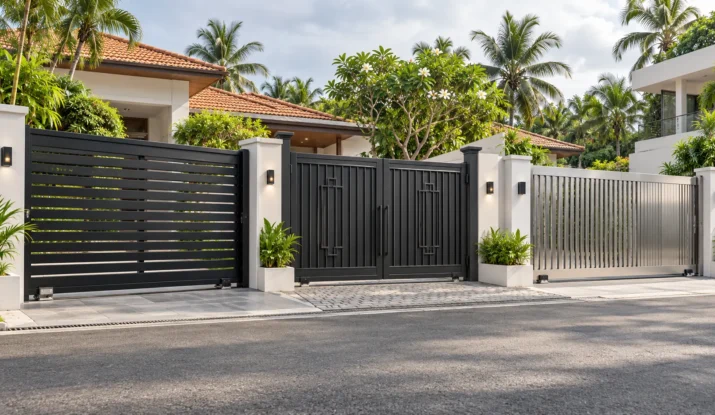
A gate can look excellent on installation day and become a maintenance problem within a few years. The difference often starts with the metal.
For Sri Lankan properties, the right choice depends on rainfall, salt exposure, gate size, security, automation, and upkeep. Aluminium sliding gates suit many homes, but mild steel and stainless steel remain better choices for certain projects.
Fast Facts: Choosing Your Gate Metal
- Aluminium: Light, modern, corrosion-resistant, and well suited to automated sliding gates.
- Mild steel: Strong, repairable, and usually economical, but it needs reliable corrosion protection.
- Stainless steel: Strong and low maintenance, although the correct grade is vital near the coast.
- Automation: Select the motor only after calculating the completed gate’s weight, movement, wind exposure, and usage.
- Best decision: Compare the complete specification, including profiles, finish, hardware, foundations, safety devices, installation, and maintenance.
Why Gate Material Matters in Sri Lanka
Sri Lanka receives an average of about 2,000 mm of rain each year. Humidity is also high in many regions. Coastal properties face the added effect of airborne salt.
These conditions test every weld, fastener, coating, and drainage point. Poorly protected mild steel can rust. Aluminium can develop surface corrosion in aggressive conditions. An unsuitable stainless steel grade may show staining or pitting near the sea.
Weight matters too. A heavy leaf places more load on hinges, rollers, foundations, and automation equipment. A solid gate also catches more wind than an open-slat or chain-link design.
The best material is therefore not simply the strongest or most expensive. It is the material that fits the site, structure, movement, and maintenance plan.
Aluminium, Mild Steel and Stainless Steel Compared
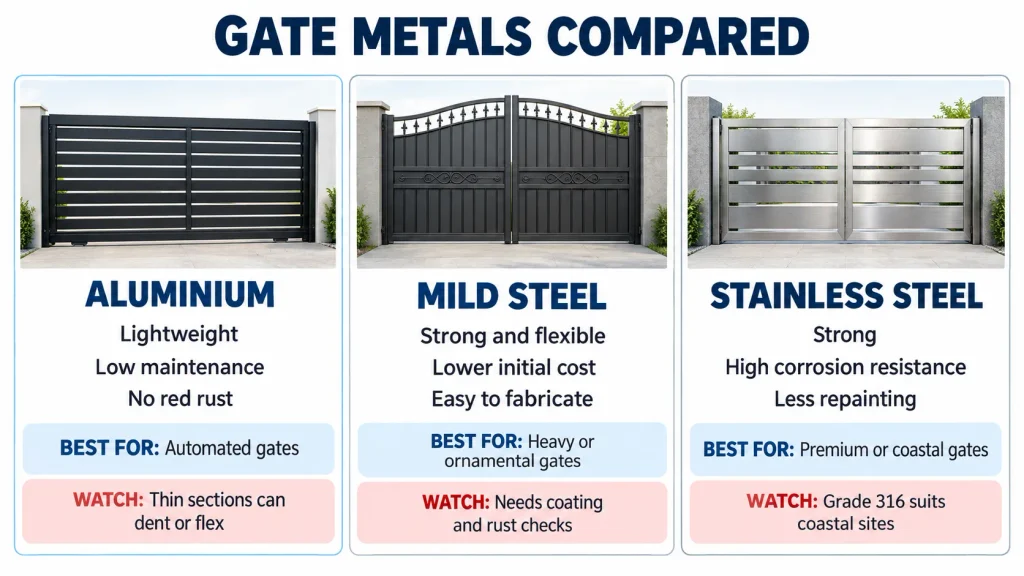
Aluminium: Light and Low Maintenance
Aluminium forms a protective oxide layer and does not develop red rust like mild steel. Its low weight makes it useful for large residential gates and automation.
A quality powder-coated aluminium gate can support modern horizontal slats, vertical battens, privacy panels, and wood-look finishes. It is a practical choice for a black sliding gate or black swing gate.
However, aluminium is not damage-proof. Thin sections can dent or flex. Wide gates need suitable profiles, internal reinforcement, good joints, and correctly supported rollers or hinges. Aluminium should also be isolated from incompatible metals where galvanic corrosion may occur.
Mild Steel: Strong and Flexible
Mild steel offers high strength, easy fabrication, and broad design freedom at a generally lower initial cost. It works well for ornamental entrances, commercial properties, heavy frames, and a double swing steel gate.
Its weakness is corrosion. Bare mild steel rusts, so durability depends on surface preparation and protection. Hot-dip galvanizing adds a zinc coating, while suitable primers, paint, or powder coating provide further protection.
Edges, welds, hollow-section openings, and damaged coating areas need careful attention. Mild steel can deliver long service, but owners must inspect it and repair coating damage before corrosion spreads.
Stainless Steel: Premium Corrosion Resistance
Stainless steel combines strength with better corrosion resistance than ordinary mild steel. It suits premium entrances, exposed sites, and owners who want less repainting.
The grade must match the environment. Grade 304 may suit many inland installations. Grade 316 stainless steel is usually the better starting point for a land-based coastal site because it has greater resistance to chloride exposure.
Stainless steel can still stain or corrode. Surface finish, fabrication quality, contamination from carbon-steel tools, salt deposits, and maintenance all influence performance. It also carries a higher initial cost and remains much heavier than aluminium.
Are Aluminium Sliding Gates the Best Choice for Automation?
Aluminium sliding gates are often a strong residential choice because the motor moves a lighter gate. Lower weight can reduce loads on rollers, guides, racks, and supporting structures.
That does not mean every aluminium slide gate needs a small motor. Installers should calculate the completed gate’s weight, travel distance, operating frequency, wind exposure, and site gradient. They should not select a motor from the opening width alone.
Sliding gates need enough clear run-back space beside the entrance. The track, or cantilever system where used, must suit the gate’s size and ground conditions. Swing gates need a clear arc and sound posts.
Material choice also does not replace safety design. Powered gates require a site-specific safety assessment. Safe installations may need guarded gears and shear points, obstacle detection, safety edges, controlled forces, secure wiring, and a manual release for power failures.
Match the Metal to Your Design and Security Needs
Beautiful sliding gates depend on proportion and workmanship more than decoration. A simple aluminium gate with aligned slats can look better than a complicated gate with poor joints.
For a modern Sri Lanka gate design, powder-coated aluminium provides clean lines and many colour options. Black finishes are popular, although dust, salt, scratches, and coating fade can be more visible. Ask for an exterior-grade coating system and clear maintenance instructions.
Mild steel offers greater freedom for scrollwork, laser-cut panels, and heavier ornamental details. Stainless steel suits brushed, polished, or contemporary geometric designs.
For an industrial boundary, a chain link fence sliding gate provides visibility and low wind resistance. It may suit compounds, service entrances, and utility areas better than a solid privacy gate.
Security depends on the whole assembly. Check the frame, infill spacing, guides, stops, locks, posts, foundations, fasteners, and automation controls. A thick-looking panel on a weak frame does not create a secure entrance.
Five Expensive Gate-Buying Mistakes to Avoid
- Buying by material name alone. Ask for the alloy or steel grade, profile dimensions, wall thickness, hardware, and finish in writing.
- Comparing only the first price. Include repainting, cleaning, corrosion repairs, replacement hardware, and possible automation upgrades.
- Using the wrong stainless grade near the coast. Confirm the actual grade and specify compatible fasteners.
- Ignoring drainage and coating details. Water traps, unfinished tube ends, contaminated surfaces, and poorly treated welds shorten gate life.
- Adding automation after construction. Plan the gate, foundations, electrical supply, motor, manual release, and safety devices as one system.
Also consider wind before choosing solid infill. A large closed gate can place substantial forces on posts and actuators. Strategic gaps or slats may reduce that load while preserving privacy.
A Practical Material Decision for Your Property
Choose aluminium when low weight, modern styling, corrosion resistance, and automation are priorities. It is often the most balanced option for aluminium sliding driveway gates at residential properties.
Choose mild steel when you need strong construction, detailed fabrication, easy repair, or tighter control of the starting budget. Commit to a suitable coating system and periodic inspection.
Choose stainless steel when you value a premium finish and reduced repainting. Specify the grade carefully, especially near the coast.
No material can compensate for weak design or poor installation. Before ordering, request a site assessment and a written specification covering the frame, infill, finish, hardware, foundations, automation, safety devices, and maintenance.
Vision Industries can help assess these factors, manufacture a gate to suit the property, install the system, and provide ongoing support across Sri Lanka.
Frequently Asked Questions
Which metal is best for a gate in Sri Lanka?
Aluminium is often the best balance for automated residential gates, while mild steel suits strong, budget-conscious designs. Stainless steel suits premium or exposed locations. The final choice should reflect coastal exposure, gate size, security, maintenance, and the quality of fabrication.
Do aluminium sliding gates rust?
Aluminium sliding gates do not develop red rust like mild steel. However, aluminium can suffer surface or galvanic corrosion when exposed to salt, trapped moisture, or incompatible metals. Suitable alloys, good drainage, proper isolation, and an exterior-grade coating improve long-term performance.
Is aluminium or stainless steel better for a coastal gate?
Powder-coated aluminium and correctly specified stainless steel can both suit coastal gates. Aluminium offers lower weight, while grade 316 stainless steel offers greater strength. Compare the exact alloy, grade, finish, fasteners, cleaning requirements, gate size, and total installed cost before deciding.